
A stronger finance function for a stronger green-industry business.
Profit in Bloom brings accounting, profitability analysis, planning and financial management together around the way your green-industry business actually operates. The result is clearer visibility into performance, what lies ahead and the financial context behind consequential decisions.
Financial expertise + firsthand green-industry operating experience

The information exists. It just doesn't connect.
Your business may already have accounting reports, estimates, payroll data, job information and operating systems. The problem is that you’re still left connecting the pieces—trying to understand what’s driving the numbers, what needs attention and what to do next.
The numbers show what happened—but not always why.
Financial results can be disconnected from the labor, pricing, production and equipment decisions that created them.
Important decisions still depend too much on instinct.
Hiring, pricing, equipment and growth decisions are harder when the relevant financial and operating information isn’t assembled in one context.
Profit leaks can hide inside otherwise healthy revenue.
Weak labor recovery, pricing, utilization or production performance may not be obvious from topline reporting.
Issues can be identified without clear follow-through.
Even when a problem is recognized, responsibility, implementation and measured results may remain unclear.
You shouldn’t have to be the one connecting every financial and operating piece just to understand how the business is performing.
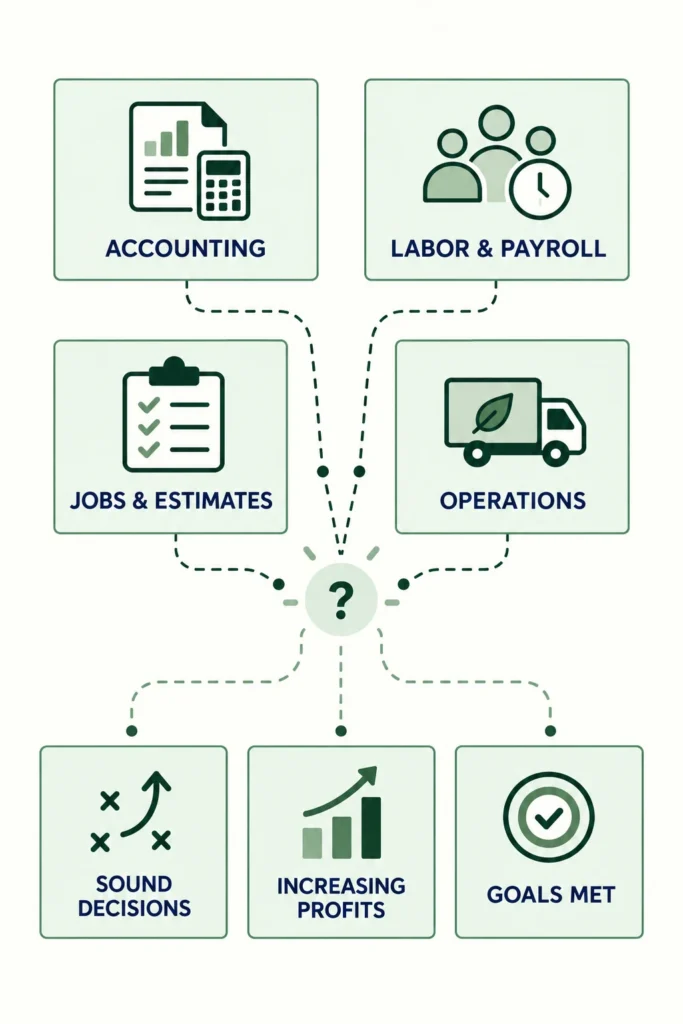
One connected finance function.
The numbers you use to run the business should reflect what is happening in it. Reliable financial records feed profitability analysis, and that analysis supports forward-looking management.
Accounting, Tax & Financial Operations
Create a reliable financial foundation
Profitability, Pricing & Job Economics
Understand what drives profit
Planning, Performance & Financial Management
Inform the decisions that shape what comes next
Keep the financial foundation current,
coordinated and ready to use.
Accurate books are only part of the job. Day-to-day accounting, administration, reconciliations, month-end close and tax compliance need to work together so the financial information stays current and ready to use. That foundation makes job-profitability analysis, forecasting and management decisions more dependable.
Ongoing bookkeeping
Reconciliations and journal entries
Monthly close
Accounts payable
Accounts receivable
Payroll administration
Sales-tax filings
Income-tax preparation

Know what your work actually costs—and what it needs to earn.
Profit in Bloom connects estimating, labor, materials, equipment and production to actual job profitability—so you can see where margin is earned, where it leaks, and what needs to change.
Labor
Materials
Subcontractors
Equipment
Estimate → Actual → Variance

Which jobs and services actually make money?
- Job profitability
- Estimate vs. actual
- Gross margin
- Service-line profitability
Is labor producing enough profit?
- Burdened labor cost
- Productivity
- Recovery rate
- GP per productive hour
Is equipment earning what it costs?
- Ownership cost
- Operating cost
- Utilization
- Recovery rate
Are your prices and markups producing the margins you need?
- Labor
- Materials
- Subcontractors
- Equipment
- Required margin
Is field production generating enough contribution to cover overhead and profit?
- Overhead recovery
- Production economics
- Capacity economics
Better answers to expensive business decisions.
Before you add a crew, buy equipment, change prices or take on more work, you need to know what the business can afford and what each choice could mean. Forecasts, cash planning and scenario analysis provide that context.
• Can we afford another crew?
• Should we hire another estimator, PM or salesperson?
• Should we buy, finance, lease or rent this equipment?
• Can we afford a larger facility?
• Should we increase prices, and by how much?
• Should we keep, reprice or walk away from this customer?
• Is this large contract actually worth taking?
• How fast can we grow?
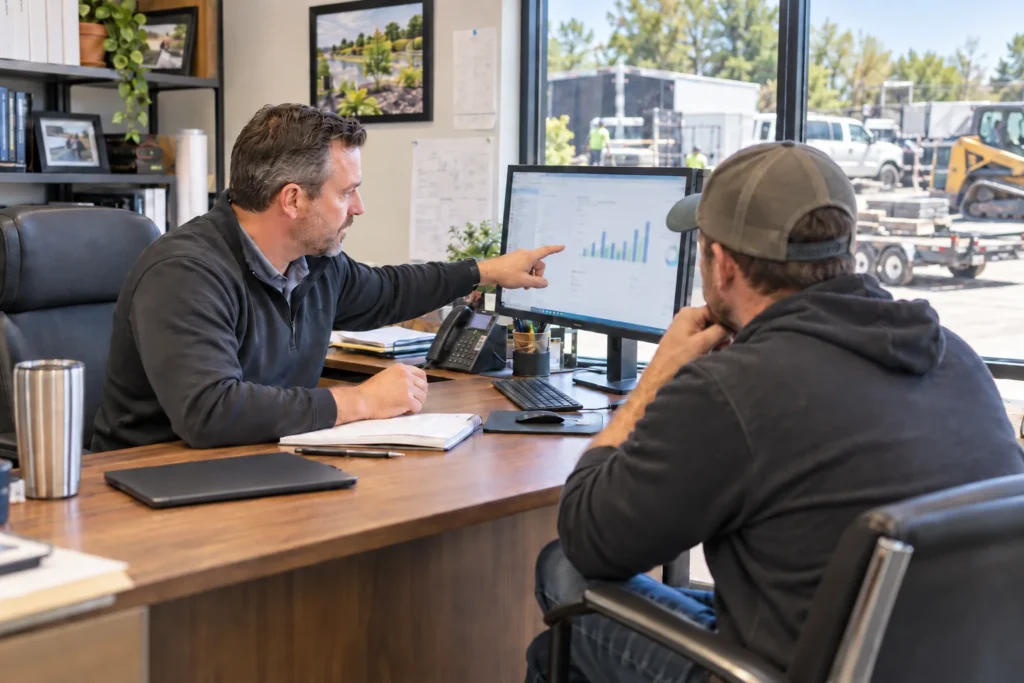
- Management scorecard and KPIs
- Annual budget vs YTD actuals
- Three to five year financial forecast
- 13-week cash-flow projection
- Scenario / decision analysis
Your financial results are created in the field.
Accurate job profitability starts long before month-end. Estimating, time capture, material and equipment allocation, and billing determine what eventually reaches the financials. Connecting those operating details to job cost and KPIs shows where the economics are being created—and where they need attention.
Estimate
Pricing assumptions · overhead recovery targets · production assumptions
Job Execution
Crew / time · materials · equipment · field production
Billing + Accounting
Billing completed work · coding costs · reconciling financial activity
Job Cost + KPIs
Estimate vs. actual · margin variance · labor productivity · recovery metrics
Management Decision
Pricing · staffing · equipment · estimating changes · growth decisions
Different systems. One financial picture.
A growing green-industry business may estimate and manage work in a platform such as Aspire, LMN, SingleOps or RealGreen, run payroll through a separate system, and keep its financial records in QuickBooks or another accounting platform.
Profit in Bloom focuses on the financial structure connecting those systems—where jobs, time, labor burden, materials, purchasing, billing and revenue are captured; what needs to reach accounting; what must reconcile; and which numbers management should ultimately trust.
Systems we understand in the financial workflow:
QuickBooks Online / Advanced · Aspire · LMN · SingleOps · RealGreen · SynkedUP · Jobber · Inova Payroll · Acumatica · and others
When specialized software configuration is required, we can work alongside the software provider or implementation partner while focusing on the accounting, job-costing, financial-workflow and reporting requirements.
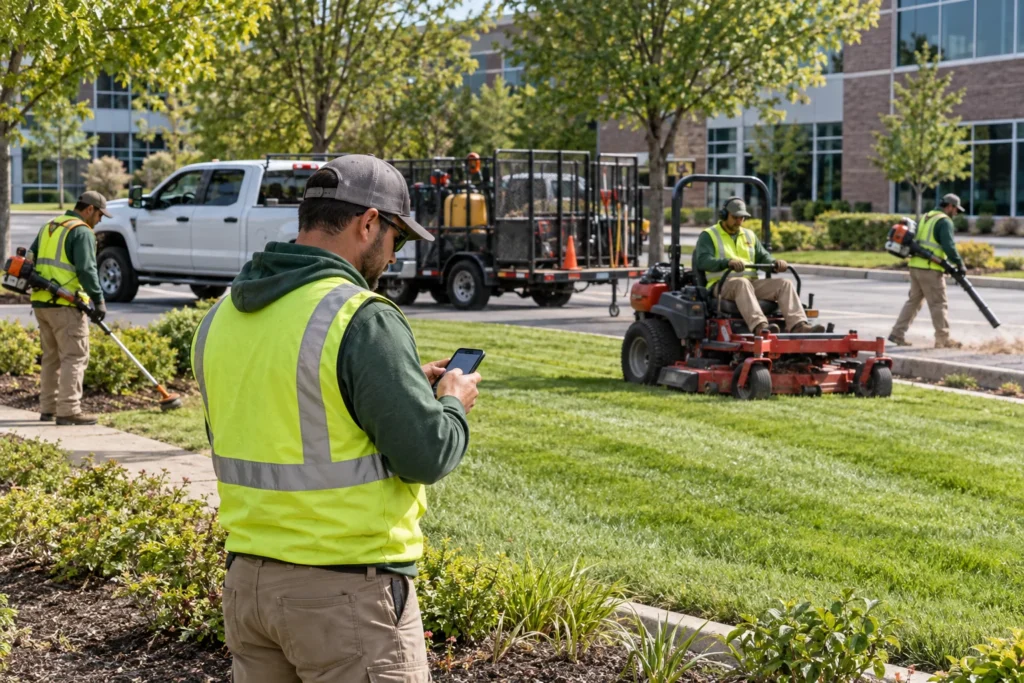
Turn insight into action—and action into measurable improvement.
Insight matters when it leads to action and the result stays visible. Opportunities are identified, analyzed and translated into specific recommendations, then tracked through ownership, implementation and measurement.
Good advice shouldn't disappear after the meeting.
For each material opportunity, you can see the recommendation, management decision, owner, implementation status and measured result.
Improvement & Action Register
Opportunities stay visible from identification through implementation and measurement.
Built for established green-industry businesses.
The best fit is a green-industry business that has outgrown transactional bookkeeping—where field operations, job economics and growth decisions require more connected financial management.
- You have employees and field crews.
- Estimating, production and job economics materially affect profitability.
- Labor, equipment and overhead need to be recovered through pricing.
- The business has outgrown purely transactional bookkeeping.
- You need reliable financial context for consequential decisions.
- You want the financial function connected to how the company actually operates.

Financial expertise is more useful with firsthand operating experience.
Profit in Bloom combines accounting and financial-management experience with firsthand green-industry operating experience, bringing financial discipline to the practical realities of running and growing the business.
Do I need every service Profit in Bloom offers?
No. The three service areas work together as one connected finance function, but the specific responsibilities Profit in Bloom owns can be tailored to your existing team, providers and needs.
Can you work with our existing bookkeeper, CPA or internal staff?
Yes. Profit in Bloom can work alongside your existing bookkeeper, CPA, tax preparer, or internal staff. We first look at who is already doing what well, then define where we should fill gaps, improve reporting, strengthen financial management, or take ownership of work that is not being handled effectively. The goal is not to replace capable people unnecessarily. It is to create a finance function that works together and gives the owner reliable information and better decision support.
What will we actually receive each month?
What you receive depends on the scope of the engagement, but the goal is always to turn financial information into something you can actually use to run the business. Ongoing work may include accurate books and reconciliations, monthly financial statements, management reporting, cash-flow visibility, job or division performance analysis, budgets and forecasts, KPI review, and regular discussions focused on decisions and priorities. We define the recurring deliverables and working cadence at the beginning of the engagement.
Is this outsourced accounting or fractional CFO work?
It can include both. Traditional outsourced accounting focuses primarily on keeping the books accurate and completing recurring accounting work. Fractional CFO work focuses more on analysis, planning, cash flow, performance, and major business decisions. Profit in Bloom is designed to connect those layers so the information produced by accounting flows into management reporting and better owner decisions. The scope can lean more heavily toward execution, financial leadership, or both depending on what the business needs.
How involved does Profit in Bloom become in our business?
We become involved enough to make the finance function work without creating unnecessary work for the owner. During onboarding, we may need time with you and your team to understand your systems, workflows, reporting, job costing, and priorities. After that, the ongoing cadence is designed to reduce the amount of financial work and follow-up that sits with the owner. We do not need to be involved in every operational decision, but we stay close enough to the numbers and the business to identify issues, improve visibility, and help management make better decisions.
Which businesses are the best fit?
Profit in Bloom is built for established green-industry businesses that have reached a level of operating and financial complexity where basic bookkeeping is no longer enough. Many clients will be in roughly the $1 million to $10 million-plus revenue range, but revenue is a guideline rather than a strict cutoff. The strongest fit is usually a business with employees, crews, equipment, multiple jobs or service lines, and an owner who wants better accounting, job-cost visibility, cash-flow management, reporting, planning, and financial decision support.
How does an engagement begin?
It starts with a consultation to understand your business, current accounting and finance setup, systems, challenges, and priorities. If there is a good fit, we define the initial scope, responsibilities, information access, and onboarding plan. Early work may include validating or cleaning up financial information, improving account structure or job costing, connecting systems, and establishing useful reporting. From there, we move into an ongoing operating cadence with clear responsibilities, recurring deliverables, and regular financial review.
How are scope, fees, and the engagement structured?
Engagements are tailored to the responsibilities and level of support your business actually needs rather than forcing every company into the same package. Fees depend on factors such as the scope of work, complexity of the business, condition of the current accounting and reporting, systems involved, and the amount of ongoing support required. Profit in Bloom is primarily designed for ongoing relationships rather than one-time consulting projects. Before work begins, we provide a clear scope and fee structure, and any commitment or termination terms are stated in the engagement agreement.
Build a finance function that helps you run the business—not just report on it.
Tell us how your finance function works today, where visibility is breaking down and what you’re trying to improve. We’ll determine whether there is a strong fit and what role, if any, Profit in Bloom should play.